
Door-to-Door Poetry, as defined by me, is the act of knocking on a strangers’ door and offering to write a poem for them, for free, on any subject of their choosing.
‘How does that work,’ you ask? Well, I pick a street. I do not know anyone on that street. When someone answers the door, I ask them what’s important to them. We have a conversation about it and then I go home. Two weeks later, I return to deliver the poem. I perform each one on the doorstep for every person, before giving them a written copy.
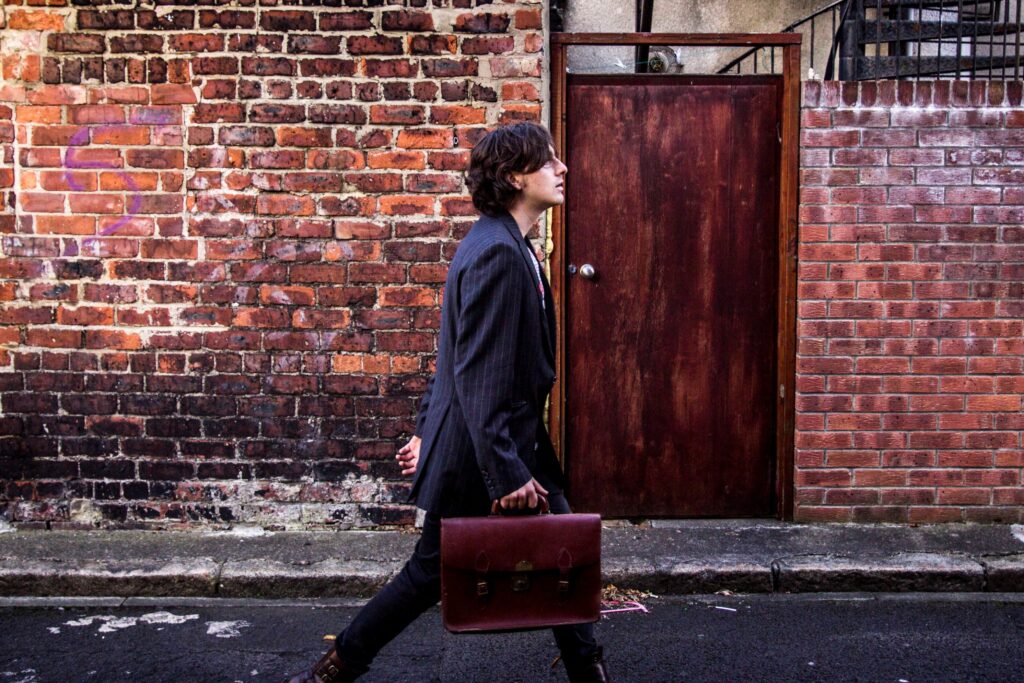
I started Door-to-Door Poetry in 2015 in Newcastle upon Tyne. From 2019 to 2020, I secured Arts Council funding to take the concept to 12 places across England. In this time, I spoke to hundreds of people and wrote a total of 64 poems.
If this is the first time you’ve ever heard about this, I imagine you’ve probably got some questions. But I’m going to conveniently skirt around those for now, because I want to focus the subject of this blog post on the technical side of the process; on the way going door-to-door has affected my writing and the lessons it has taught me about making meaningful poetry.
Because there is an attitude, seldom uttered but ever-present, that writing poetry for other people is cheap- that it is more noble and righteous to only ever write poetry for yourself. Like many of us, I have been guilty of viewing commissions as the work that ‘needs’ to happen, so as to allow me the time and space to make my ‘real’ poetry at a later date.
But I have learned through being a Door-to-Door Poet that there are many benefits to embracing the process of writing for others, ones that go much further and deeper than the scope of this one project. I want to argue here that, through meeting strangers and writing for them, there are a lot of useful skills we can develop and a lot of valuable insights we can make, experiences which broaden our perspective and help us to become more fully-rounded writers.
The first and most obvious benefit of writing poems for other people is that you learn a lot. When you start knocking on strangers’ doors and asking what’s important to them, you very quickly become acquainted with the magnitude of your own ignorance. On my first few outings as a Door-to-Door Poet, I met a surfing enthusiast, a highly unconventional doctor, a bonsai tree expert and a judo champion. Whether it was a discipline, a skill, an emotion, or a life experience, everyone I spoke to had their own specialist subject. It was usually something I knew very little about.
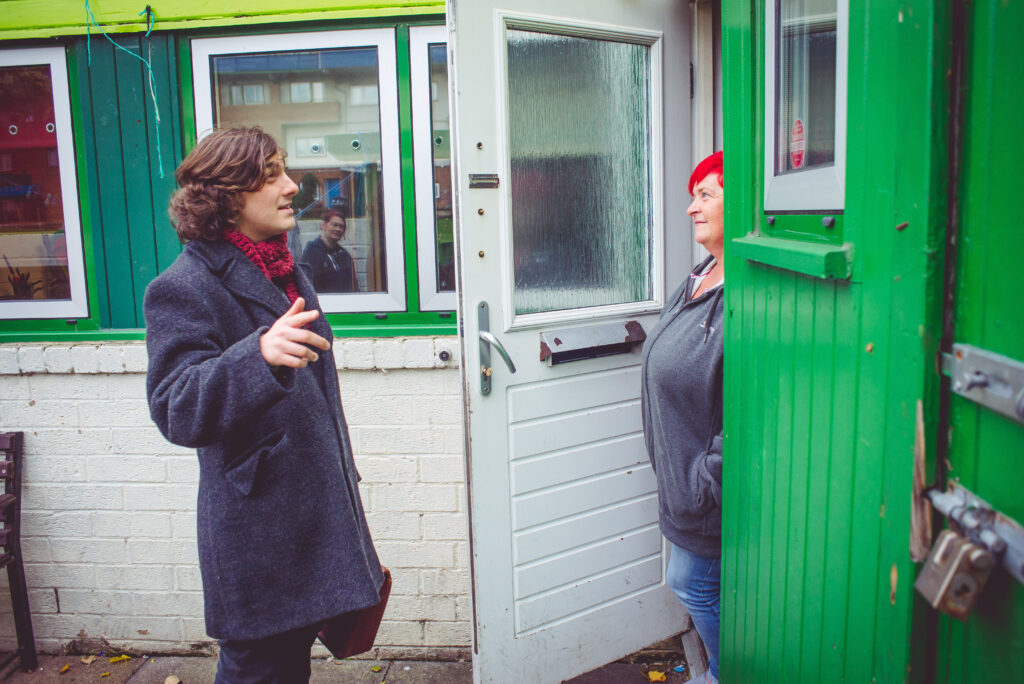
I came to appreciate that this was a very spontaneous way of forcing myself to be more curious. One of the most rewarding examples of this was meeting a man called Sami in the west end of Newcastle. He asked for a poem about Islam. Not knowing very much about the subject, I decided to visit a mosque for the first time in my life. I had a fascinating conversation with the local Imam there, who spoke about the relationship between poetry and the Quran. I came to really enjoy the little rabbit holes this project could lead me down. It was a reminder that everything, if we view it properly, is an opportunity to learn and to grow.
But before we can really learn anything, we need to know where to find it. And the second insight I gained from writing for lots of other people is that it makes you a better listener. Assembling poems on my own, my default setting up till this point had often been to try to persuade the reader, to cajole them into seeing the world through my eyes.As the Door-to-Door Poetry project took shape, it became clear that this wasn’t about persuading anyone, or trying to demonstrate how clever I was. It was about listening and holding the space until I found an earnest moment of connection.
It’s amazing where this can take you. One woman in Bensham, near Gateshead, originally told me she had ‘nothing interesting to talk about’. She went on to detail the story of how she single-handedly rescued her entire family from a housefire, carrying both of her children, one on each shoulder, before running back in to drag her unconscious husband from the flames. Later, in Moss Side – Manchester, a man who asked to be referred to as The Specialist started off by talking about the architecture of council estates. He ended up comparing me to an 18th century time traveller and asking for a poem about that. None of these conversations would have happened if I had entered the process with any objective. Whether we are writing for ourself or for others, we can always benefit from taking the time to listen more closely.

The third, and perhaps the most memorable, lesson I have gained from Door-to-Door Poetry is that every poem is a collaboration. As time went on, I came to see that the conversations I was having, and the resulting poems that came out of them, existed as part of a partnership. On the most basic level, these poems could not have been written without both me and the person on the doorstep. In every encounter, we were working together, brainstorming and sketching out ideas in a short but meaningful relationship.
But the more I experimented with this way of thinking, the more I came to see that this isn’t just about Door-to-Door Poetry. The fact of the matter is, whether we choose to accept it or not, every poem is a collaboration: Between your current self and your past self. Between you and the subject you are observing. Later, between you and an editor, or a proofreader, or a reader. At any given stage, if we look close enough, we can see that what we are making cannot happen without some degree of interdependence.
This might seem like a simple idea, but embracing it can have a profound effect on your approach. The spotlight is shifted from the ego. Writing is no longer about ‘my thoughts, my idea, my poem’. It is about us. Our shared experience. Our feelings. Our lives. It is, I believe, an example of what the Buddhist teacher Thich Nhat Hanh called the state of ‘interbeing’- the idea that none of us exist in isolation, that we are always in a relationship with everything around us.
Writing for other people doesn’t have to happen on a doorstep. It can take place on a bus, in a café, in the workplace or at home. Wherever it is happening, it can pass on very valuable skills for us as writers. As we begin to listen more closely and to put the idea of collaboration into practice, we can move away from lecturing, or excessive erudition. We can move instead towards a desire to make a genuine connection in our work, to express ourselves in a way which is inclusive and engaging. The resulting poetry is, in my experience at least, all the better for it.
About Rowan McCabe
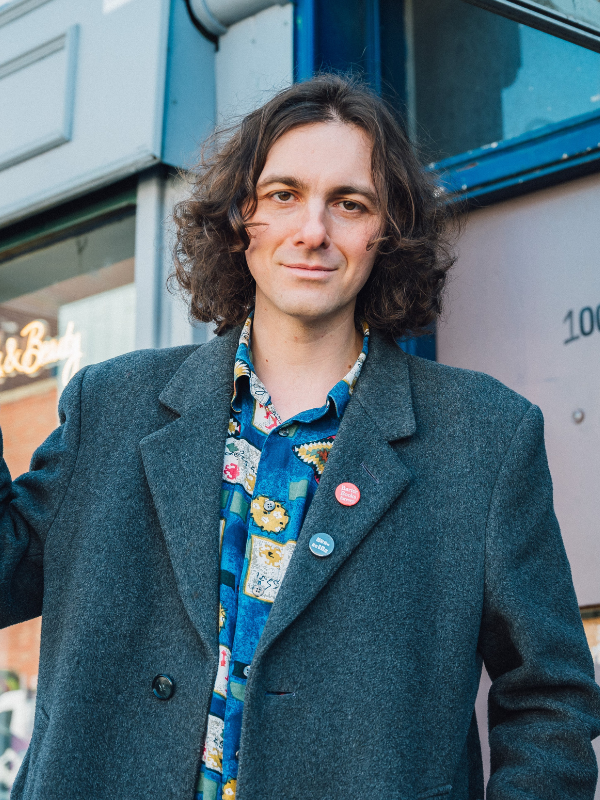
Rowan McCabe is a poet and performer who has written for Channel 4, BBC Radio 3’s ‘The Verb’ and the National Trust. His work has been featured in the Guardian and on BBC Breakfast. He has toured across the UK and has appeared at Glastonbury Festival and the Royal Albert Hall. Rowan’s first full-length book, The Door-to-Door Poet, was published by Eye Books in September 2025.
www.rowanthepoet.co.uk
 Insert HTML here